Drivers In Labview Vi
This document describes style guidelines, functional best practices, distribution licensing compliance obligations, and installation directions to consider while developing your Add-on driver or VI Library for National Instruments LabVIEW software. It also identifies requirements which must be met in order for your driver or VI Library to be eligible for consideration for acceptance in the Compatible with LabVIEW program and use of the “Compatible with LabVIEW” logo. Eset Nod32 Antivirus 4 Username Password Free. * Table of Contents • • • • • • • •. New Compatibility Guidelines for Add-ons for LabVIEW As the continues to grow, it is more important to distinguish which of the more than 400 available Add-ons meets a level of compatibility that helps to ensure developer success.
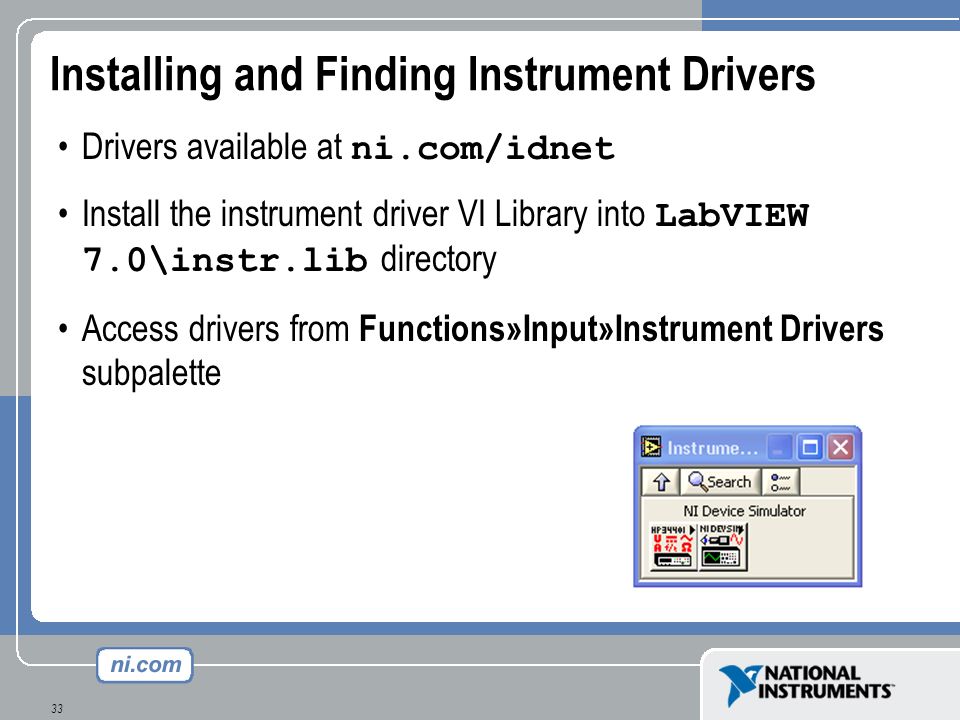
To access the palette, switch to your LabVIEW block diagram (the development window with the white background), right-click to open your Functions palette, and navigate to Instrument I/O » Instrument Drivers to see the drivers you have installed. Navigate to the Instrument Driver Palettes. Many instrument drivers contain the VI Tree. To interface external software or hardware with LabVIEW, you can develop drivers and VI libraries in LabVIEW or create a DLL in another language and call it from LabVIEW. Use LabVIEW as much as possible for API development to maximize transparency for the end user and minimize your development time by avoiding working in multiple languages. Using an Instrument Driver in LabVIEW. In LabVIEW, an instrument driver is a set of VIs that communicates with an instrument. Each VI corresponds to a programmatic operation, such as configuring, reading from, writing to, and triggering an instrument. TraNET LabVIEW Instrument Driver. This LabVIEW Plug and Play (project-style). VI Tree – Gives a schematic overview over all VIs contained in this driver.