Transformer Winding Calculation Software
If you have some experience in assembling transformers, then this program is perfect for you. If you don’t known anything about assembling transformers, please don’t use calculations from this program for building your own transformer! Wrong calculation can do damage to your electric device attached to electric network, and IT CAN KILL YOU!!! You can still use this program to determine how big EI core of transformer must be, if you plan to buy transformer. Note there are lot of transformers that are hybrids, so if you need transformer for amplifire buy right sized transformer.
Hybrid transformer are ordinarily small and under high load it can overheat.
By using the same perimeter value for both primary and secondary, you implicitly assume that windings are side by side (split bobbin) rather than one over the other. Standard practice is to use not perimeter but mean length of term (MLT), thus the stated wire lengths are too long.
Magnetic Builder is a magnetic design software to design magnetic component, inductor,transformer, coil, with different ferrite or powder core material. Detailed transformer drawing is generated.
The winding area is not filled 100% because the wire is round and has air included in the winding cross section. Standard practice is to use a fill factor which tends to be around 60% when winding technique and insulation thickness are included. This affects the choice of wire gauge to fit the cross section. From wire length and gauge the next step is to calculate resistances from which the voltage drops can be known, noting that AC resistance will be somewhat greater than DC resistance. Then the design can be iterated to compensate.
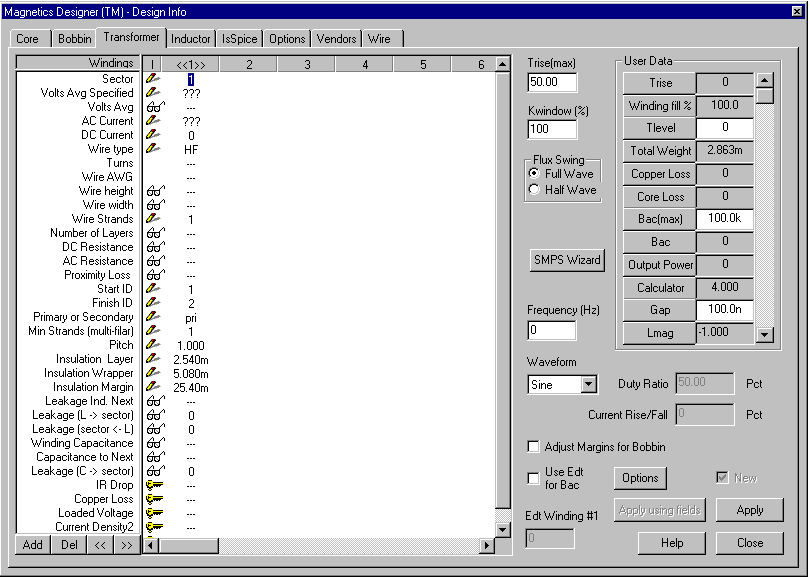

When you calculate the core area you assumed Te = 4 (turns per volts) but it was not clear where this number 4 comes from. In other calculations the core area is proportional to the squareroot of VA and approximated as Ai = 1.152*sqrt(Output voltage x output current) = 1.152*sqrt(50VA) = 8.146 cm^2=8.146*10^-4 m^2 and then using this Ai value the turns per volt is calculated Te = 1/(4.44AiBf) = 1/(4.44 * 8.146*10^-4m^2 * 1.2T * 50Hz) = 4.6 turns per volts which is close to 4 that you assumed. So actually the turns per volts come from the area and not in the other way because the are comes from the VA. So we don't have to assume anything because everything comes from somewhere. Apart from this your work is nice. That was the only thing that was not understandable and i had to look it up. Thanks for your post.
As per formula given in start of article, flux density and frequency are inversely related. Windows 95 Virtualbox Image here. But, normally in designing flux density is taken constant (as flux required is constant and area is constant).
So, if frequency changes the compensation is made on voltage side. Transformer will be designed accordingly with voltages. But in small transformers such parameters are neglected mostly.
(but if you want to, Bm will be constant and voltages will be changed.) P.S: sometimes tolerance voltage compensate this change.